Overview
AI-Assisted Job Application Tracker is a productivity-focused web application designed to help job seekers organize and manage their application pipeline efficiently.
Unlike traditional job trackers that require manual data entry, this platform uses AI to automatically extract important details from job descriptions and create structured application records. Users can simply paste a job posting, and the system automatically identifies key information before placing the application into a Kanban-style workflow.
Motivation
This project was originally developed as an evaluation task for an internship role, serving as a hands-on opportunity to learn and demonstrate rapid full-stack development and AI integration.
While applying for jobs, I found myself repeatedly performing the same tasks:
- Copying company names
- Entering job titles manually
- Tracking application stages
- Managing multiple job boards
- Updating spreadsheets
This process quickly became repetitive and time-consuming. The goal of this project was to tackle the evaluation prompt by reducing this friction, combining AI-powered information extraction with an intuitive drag-and-drop workflow.
Core Features
AI-Powered Job Parsing
Users can paste an entire job description into the application. The AI system automatically extracts:
- Company name
- Job title
- Location
- Employment type
- Required skills
- Experience requirements
The extracted information is then converted into a structured application record.
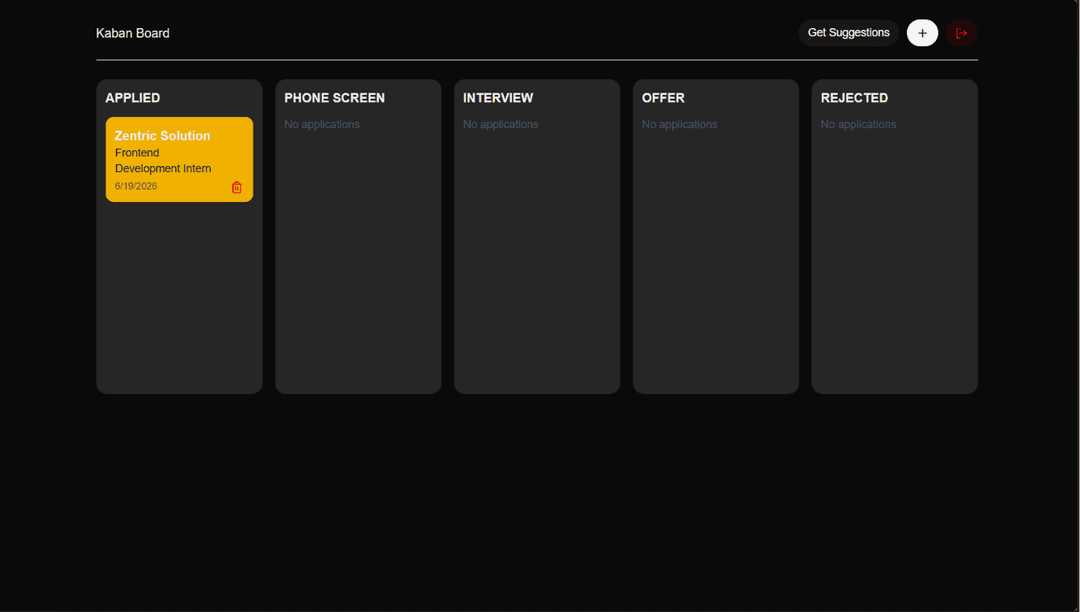
Kanban Workflow Management
Applications move through customizable stages:
- Applied
- Screening
- Interviewing
- Offer
- Rejected
Users can visualize their entire job search process from a single dashboard.
Drag-and-Drop Interactions
The application provides a smooth drag-and-drop experience for managing application status. Users can:
- Move applications between stages
- Reorganize priorities
- Update workflows instantly
State updates occur immediately, creating a responsive user experience.
Application Dashboard
The dashboard provides:
- Centralized application management
- Status tracking
- Organized workflow visualization
- Quick access to job details
This helps users maintain a clear overview of their job search progress.
High-Level Workflow
Job Creation Flow
- User finds a job posting
- User pastes the job description
- AI processes the content
- Structured information is extracted
- Application card is created
- Card appears in the Kanban board
Application Tracking Flow
- User reviews application status
- User drags card to a new stage
- State updates instantly
- Changes are persisted
- Board reflects the latest pipeline status
AI Extraction Pipeline
The core intelligence of the platform comes from its information extraction workflow.
Processing Steps
- Receive raw job description
- Clean and normalize content
- Send context to Gemini
- Extract structured fields
- Validate output
- Create application record
This eliminates repetitive manual entry while maintaining consistency across applications.
Prompt Engineering Strategy
The AI model is instructed to return structured information only. Expected outputs include:
- Company Name
- Role Title
- Location
- Skills
- Experience Level
By enforcing a predictable response structure, the system can reliably transform unstructured text into application records.
Drag-and-Drop Architecture
The Kanban board is designed around column-based state management. Each application contains:
- Unique identifier
- Status
- Metadata
- Position information
When a card is moved:
- Source column is updated
- Destination column is updated
- Local state changes immediately
- Changes are synchronized with storage
This creates a fluid and responsive experience.
Technical Challenges
Extracting Consistent Job Data
Job descriptions vary significantly between companies. Challenges included:
- Different formatting styles
- Missing information
- Inconsistent terminology
This was solved through prompt refinement and structured extraction rules.
Managing Drag-and-Drop State
Keeping board state synchronized while maintaining smooth interactions required careful state management. The solution involved:
- Optimistic UI updates
- Predictable state transitions
- Efficient re-rendering
Balancing Automation and Control
While AI handles data extraction, users still retain full control over application information and workflow progression. This creates a balance between automation and user ownership.
Tech Stack
Frontend
- Next.js
- React
- TypeScript
- Tailwind CSS
AI Integration
- Gemini API
- Prompt Engineering
- Structured Data Extraction
State Management
- React State
- Drag-and-Drop Logic
Deployment
- Vercel
Future Improvements
Potential enhancements include:
- Resume-to-job matching
- AI-generated cover letters
- Interview preparation suggestions
- Application analytics
- Email integration
- Automatic job scraping
- Calendar synchronization
Impact
The AI-Assisted Job Application Tracker transforms a traditionally manual process into an intelligent workflow.
By combining AI-powered information extraction with a Kanban-style interface, the platform helps users focus on applying for jobs rather than managing spreadsheets and repetitive data entry.
The project demonstrates practical experience with:
- AI integration
- Prompt engineering
- Information extraction
- Interactive frontend architecture
- Drag-and-drop systems
- Full-stack application development